
Ever Evolving
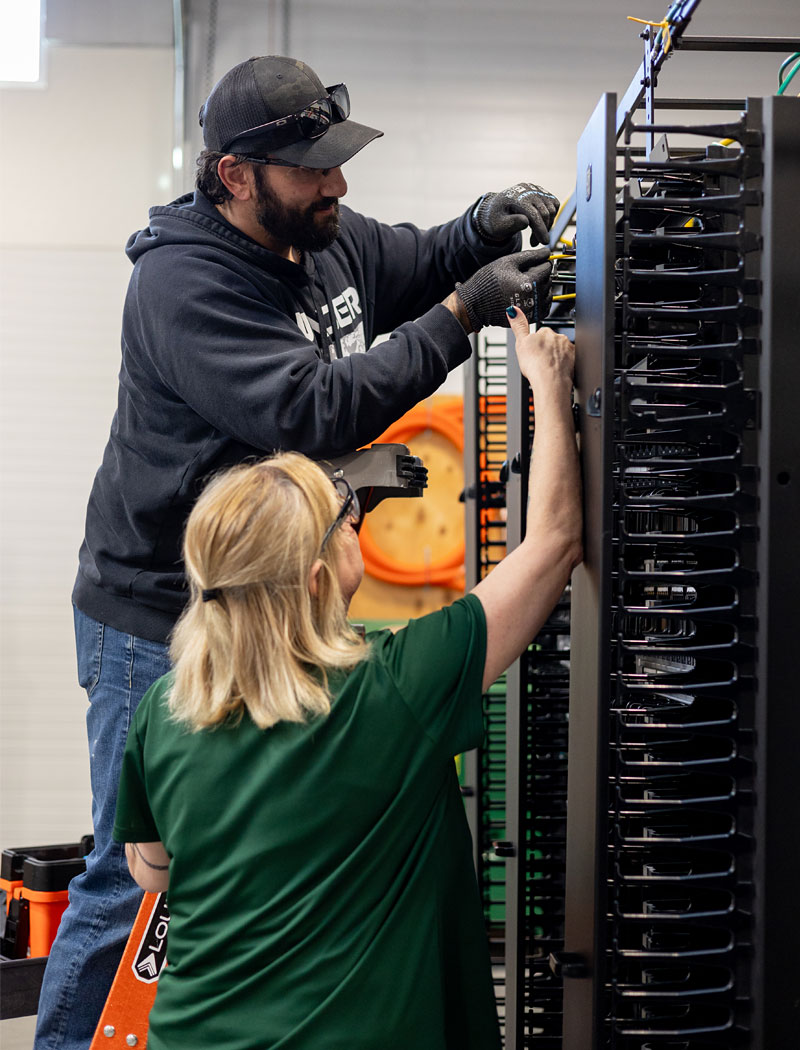
The Telecommunication (VDV Installer) Technician installs the network of low-voltage cabling systems used for voice, video, data, and other signaling applications.
While installations are typically performed in partially or fully enclosed structures, work often occurs before climate control systems or permanent lighting are in place.
Backbone voice and data cables are routed between the entrance facility, where communications signals enter a building, to equipment and telephone rooms. Voice and data horizontal cables are routed between telephone or equipment rooms and individual workstations throughout the building.
Equipment rooms often contain energized equipment such as hubs, file servers or telephone switches. These devices are configured and connected to the communications network that serves the building and must not be interrupted.
The Telecommunication apprentice installs voice and data outlets at workstations. In addition, they install punch down blocks and cross connects in telephone rooms. These may be wall-mounted or rack-mounted and must be grouped and identified according to specific installation standards. Whether the work is in new construction or in existing office or manufacturing space, the IBEW-NECA craftsperson takes pride in the work he or she has and can performed.
Work & School
The Telecommunication program consists of 6,000 hours of on-the-job training and 540 hours of classroom education. When the Telecommunication apprenticeship is completed, they will receive the completion certificate and be a Communication Technician.
Earn While You Learn
Apprentices in this program attend classes for one week at time and will work about 6 – 8 weeks in-between. The cost of books, modules and tuition for the semester are paid by the apprentice.
Apprentices receive structured pay raises as they complete satisfactory progress of on-the-job training and school hours.
Program Requirements
Requirements
- Must be at least 18 years old.
- High School Diploma or GED (Must have completed one year Algebra or its equivalent with passing grade.)
- Physical requirements: Work on ladders, scaffolds, poles, and towers, work in confined spaces, lift 25–50-pound objects and use various hand and power tools.
Documentation:
- Driver’s License or Passport or State Issued Identification Card
- Social Security Number
- Birth Certificate
- High School Transcripts
- High School Diploma or GED
If you do not meet the Algebra requirement for application, you have the following options:
- Complete the NJATC Tech Math course and submit documentation showing a passing score of 75% or higher. Course information is available at: https://electricaltrainingalliance.org/Learning/OnlineTechMath
- Complete an Algebra course through an accredited college, adult education program, or approved online institution. The institution must be accredited by a State Education Agency, and you must earn a passing grade. Official transcripts or documentation must be submitted to verify completion.
A completed application along with copies of the required supporting documents must be submitted within thirty (30) days of the application date.
**NOTICE** Our contractors’ jurisdiction covers the entire state of Utah, from Logan to St. George. You can be assigned to work anywhere within the State. It is essential that you are willing and able to travel and work wherever the job requires.
Minimum requirements to apply to this program
- Must be at least 18 years old.
- Must be a high school graduate or have a GED.
- Must have completed one (1) full year of high school Algebra (or equivalent) with a passing grade/ credit OR one (1) quarter of college Algebra with a passing grade/ credit
- Must possess and maintain a valid driver’s license.
- Physical requirements: Work on ladders, scaffolds, poles, and towers, work in confined spaces, lift 25–50-pound objects and use various hand and power tools.